Demystifying Copeland Scroll Commercial Efficiency Standards: The Foundation of Sustainable Corporate HVAC
In an era defined by stringent global energy mandates and aggressive sustainability targets, commercial heating, ventilation, and air conditioning (HVAC) systems are no longer mere comfort amenities. They represent critical operational infrastructure. The thermodynamic heart of any modern commercial climate control system is its compressor, and within this domain, Copeland Scroll compressors have long served as the undisputed industry benchmark.
This guide provides building owners, facility managers, consulting engineers, and procurement officers with an exhaustive analysis of Copeland Scroll Commercial Efficiency Standards. We explore how these efficiency metrics influence operational expenditures (OPEX), dictate corporate carbon footprints, and shape intelligent corporate HVAC procurement strategies. Master these concepts: commercial HVAC systems account for 40% to 60% of a facility’s total baseline energy consumption.
Selecting the correct compression technology is a mission-critical engineering decision. It extends beyond peak cooling capacity or BTU ratings; it requires evaluating how a compressor performs across its entire lifecycle, particularly under the part-load conditions that dominate over 90% of commercial operating hours. Understanding the engineering nuances behind SEER, EER, and specifically Integrated Part Load Value (IPLV) is the differentiator between an HVAC plant that drains capital and one that drives substantial, long-term operational savings. A higher initial capital expenditure (CAPEX) on high-efficiency compression consistently yields rapid Return on Investment (ROI) through drastically compressed lifecycle energy utility costs.
The Scroll Compression Revolution: Why It Matters for Commercial Real Estate
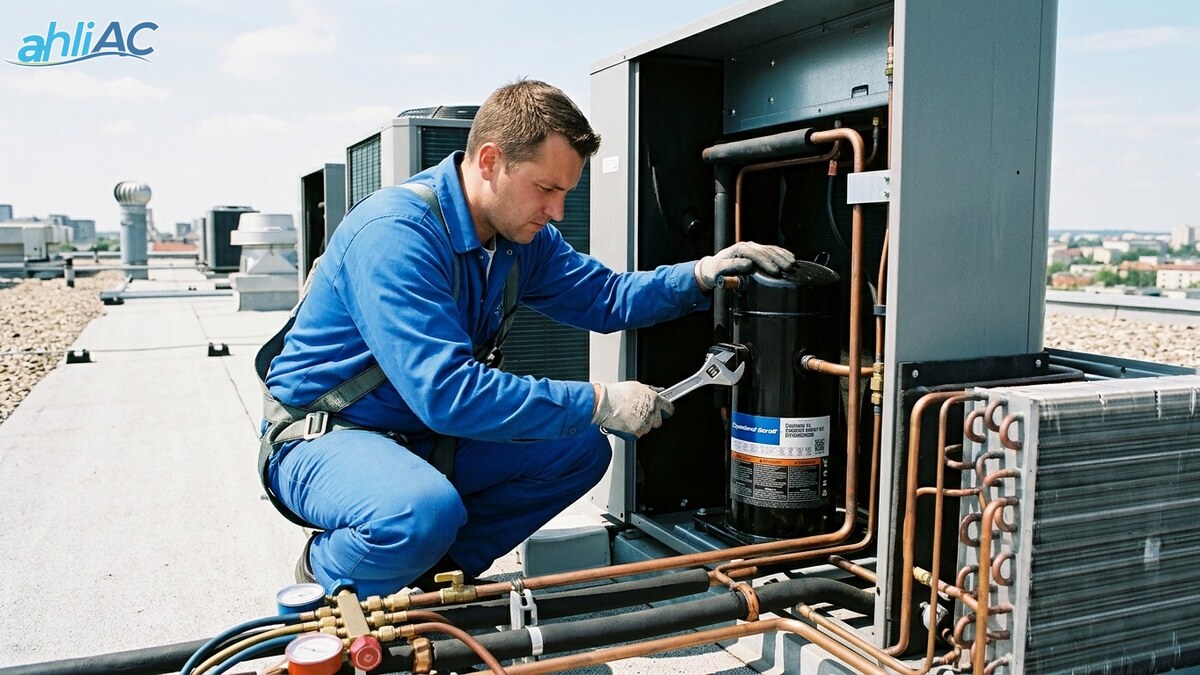
Since their commercial introduction in 1987, scroll compressors have fundamentally altered the commercial refrigeration and air conditioning landscape. Engineered by Copeland (now part of Copeland LP, formerly Emerson Climate Technologies), the scroll mechanism replaced legacy reciprocating and rotary compression architectures by delivering superior volumetric efficiency, enhanced mechanical reliability, and significantly reduced acoustic profiles.
Mechanical Evolution and Operating Principles
A scroll compressor operates via two interleaving Archimedean spiral scrolls: one stationary and the second orbiting eccentrically around it. This continuous orbital geometry traps low-pressure refrigerant vapor at the outer boundary, progressively forcing the gas pockets toward the center of the scroll assembly as the pocket volume steadily decreases.
[Suction Intake] ➔ [Outer Scroll Pockets] ➔ [Progressive Volume Reduction] ➔ [Center Discharge Port]
This continuous, valve-free compression process eliminates the clearance volume losses and mechanical valve flutter inherent to reciprocating compressors. The structural and thermodynamic advantages of this design deliver critical operational benefits:
-
High Volumetric & Isentropic Efficiency: Continuous compression minimizes re-expansion losses and internal gas leakage, converting a higher percentage of electrical input into useful cooling work.
-
Superior Mechanical Reliability: Operating with approximately 70% fewer moving parts than traditional reciprocating compressors, scroll architectures drastically reduce mechanical wear points and failure vectors.
-
Acoustic & Vibration Attenuation: The smooth, continuous orbital motion eliminates the intense mechanical vibrations and gas pulsations characteristic of piston strokes, ensuring exceptionally quiet operation in noise-sensitive commercial environments.
-
Enhanced Liquid Slugging Tolerance: Copeland’s compliant scroll geometry allows the orbiting scroll to separate slightly under abnormal pressure spikes, allowing liquid refrigerant or debris to pass without causing catastrophic valve or scroll flank damage.
The Copeland Competitive Advantage: Core Engineering Innovations
Copeland has continuously advanced scroll architecture through rigorous R&D in metallurgy, internal porting geometry, motor stator design, and electronic diagnostics. Modern Copeland Scroll portfolios—including the ZR, ZP, ZS, and ZB series—are engineered to maintain peak thermodynamic efficiency across diverse operational envelopes and refrigerant chemistries.
Decoding Commercial Efficiency Metrics
To architect or evaluate a commercial HVAC plant, engineering teams must look beyond marketing claims and evaluate standardized thermodynamic efficiency metrics. Each metric serves a specific diagnostic purpose depending on the facility’s operational profile and regional climate.
EER (Energy Efficiency Ratio): Peak Full-Load Performance
EER measures the instantaneous cooling efficiency of a system operating at peak design full-load conditions (typically $35^\circ\text{C}$ / $95^\circ\text{F}$ outdoor ambient temperature). It is calculated as:
$$\text{EER} = \frac{\text{Cooling Capacity (BTU/hr)}}{\text{Electrical Power Input (Watts)}}$$
While critical for sizing electrical infrastructure and evaluating performance during peak summer heatwaves, EER is a static, single-point metric. It does not reflect how an HVAC system operates during spring, autumn, night-time hours, or under partial occupancy.
SEER (Seasonal Energy Efficiency Ratio): Seasonal Residential & Light Commercial Baseline
SEER evaluates cooling efficiency over a simulated entire cooling season across varying outdoor temperatures and part-load cycles. While highly relevant for light commercial rooftop units and residential split systems, SEER loses precision when applied to complex applied HVAC systems, central chiller plants, or high-internal-load commercial real estate operating in tropical or equatorial climates.
COP (Coefficient of Performance): The Universal Thermodynamic Standard
COP is a dimensionless metric representing the ratio of useful thermal energy output (cooling or heating) to the net electrical energy input, expressed in identical units (e.g., Watts/Watts or kW/kW):
$$\text{COP} = \frac{\text{Thermal Output (kW)}}{\text{Electrical Input (kW)}}$$
COP is the globally recognized standard for comparing applied chillers, heat pumps, and refrigeration systems across international boundaries, allowing engineers to evaluate thermal efficiency regardless of regional unit conventions.
IPLV (Integrated Part Load Value): The Core Commercial Metric
In real-world commercial real estate—ranging from Class-A office towers to retail malls—HVAC systems operate at 100% full design capacity less than 1% to 5% of their total annual operating hours. For the remaining 95%+ of the time, systems operate at part-load conditions (typically between 25% and 75% capacity).
Integrated Part Load Value (IPLV), defined under AHRI Standard 550/590, is specifically engineered to quantify this real-world operational reality. It is a time-weighted average efficiency metric calculated across four discrete load points: 100%, 75%, 50%, and 25% capacity.
Mathematical Formulation of IPLV
The standard AHRI calculation weighting assumes an operational distribution across a typical commercial building’s annual cooling hours:
$$\text{IPLV} = (0.01 \times A) + (0.42 \times B) + (0.45 \times C) + (0.12 \times D)$$
Where:
-
$A = \text{EER or COP at 100\% Capacity (1\% of operating hours)}$
-
$B = \text{EER or COP at 75\% Capacity (42\% of operating hours)}$
-
$C = \text{EER or COP at 50\% Capacity (45\% of operating hours)}$
-
$D = \text{EER or COP at 25\% Capacity (12\% of operating hours)}$
Engineering Takeaway: Notice that 87% of a commercial system’s operational life is spent at 50% and 75% capacity ($0.42 + 0.45$). Therefore, a compressor with an exceptional IPLV rating will generate massive OPEX reductions over its lifespan, even if its peak full-load EER is only marginally higher than a competitor’s. Copeland Scroll compressors—particularly Digital and Inverter models—are specifically optimized to maximize performance at these critical mid-load points.
Advanced Copeland Technologies Sizing Up to Global Standards
Global energy efficiency standards—including ASHRAE 90.1, AHRI Standard 550/590, and Europe’s Eurovent directives—continue to tighten equipment Minimum Energy Performance Standards (MEPS). Copeland engineers design their commercial compressor portfolios to exceed these baselines through specialized thermodynamic enhancements.
Digital Scroll vs. Inverter Scroll: Selecting the Right Modulation Architecture
When architecting variable-capacity commercial systems (such as VRF/VRV systems, multi-compressor chillers, or precision data center cooling), engineers must choose between Digital Scroll and Inverter Scroll architectures.
1. Copeland Digital Scroll Technology
Digital Scroll achieves capacity modulation through mechanical axial compliance. An external solenoid valve opens and closes a bypass port, periodically separating the upper stationary scroll from the lower orbiting scroll by roughly 1 millimeter.
-
Loaded State: Solenoid closed; scrolls engaged; 100% refrigerant compression occurs.
-
Unloaded State: Solenoid open; scrolls separated; motor spins at normal synchronous speed, but no compression occurs, reducing compressor power draw to approximately 10% (overcoming only mechanical friction).
By cycling between loaded and unloaded states within a rigid time window (e.g., a 20-second cycle), step-less capacity modulation from 10% to 100% is achieved. (e.g., 10 seconds loaded + 10 seconds unloaded = 50% thermal capacity).
-
Best Applied In: Multi-evaporator air handling systems, direct-expansion (DX) commercial rooftop units, and retrofits where VFD electrical harmonic mitigation is cost-prohibitive.
2. Copeland Variable Speed (Inverter) Scroll Technology
Inverter Scroll systems utilize a high-efficiency brushless permanent magnet (BPM) motor driven by a dedicated Variable Frequency Drive. By modulating electrical frequency and voltage, the compressor motor speed scales dynamically from 900 RPM (15 Hz) up to 7200 RPM (120 Hz).
-
Thermodynamic Advantage: Affinity laws dictate that compressor mechanical friction and internal flow resistance drop exponentially at lower rotational speeds. Operating an inverter scroll at 50% speed consumes significantly less than 50% of its full-load electrical power, resulting in unmatched IPLV ratings.
-
Best Applied In: Premium VRF commercial networks, high-end modular chillers, and precision cooling applications requiring tight $\pm0.5^\circ\text{C}$ space temperature control and maximum latent heat removal (dehumidification).
Enhanced Vapor Injection (EVI): Supercharging Cold-Climate and Heat Pump COP
For high-lift applications—such as extreme ambient cooling or commercial heat pump water heaters—Copeland utilizes Enhanced Vapor Injection (EVI) technology. EVI utilizes an external economizer heat exchanger to subcool the primary liquid refrigerant line while injecting intermediate-pressure saturated vapor directly into a dedicated mid-compression pocket within the scroll assembly.
This thermodynamic inter-cooling process reduces compressor discharge temperatures, increases refrigerant mass flow through the evaporator by up to 20%, and boosts overall system COP by 15% to 30% under high-lift operating conditions.
Strategic Corporate HVAC Procurement: The TCO Imperative
In institutional real estate and corporate infrastructure management, purchasing HVAC equipment based solely on lowest initial capital expenditure (CAPEX) is a recognized financial error. A structured corporate HVAC procurement framework must evaluate equipment through a comprehensive Total Cost of Ownership (TCO) model over a 15- to 20-year lifecycle.
The Lifecycle Cost Allocation of a Commercial Compressor
When evaluating the financial footprint of a commercial chiller plant or applied rooftop network over 15 years, initial equipment procurement represents a fraction of total capital outlay:
-
Initial CAPEX (Equipment & Installation): ~10% – 15%
-
Routine Maintenance & Component Servicing: ~10% – 15%
-
Electrical Utility OPEX (Energy Consumption): ~70% – 80%
Because electrical consumption dominates the TCO equation, specifying a Copeland Scroll compressor with an IPLV rating that is even 1.5 to 2.0 EER points higher than a legacy alternative generates hundreds of thousands of dollars in utility savings over the building’s operational lifespan.
Integrating Sustainability Metrics into Corporate Procurement
Modern corporate procurement mandates increasingly align with Environmental, Social, and Governance (ESG) criteria. High-efficiency Copeland Scroll systems directly facilitate compliance with global green building certification frameworks:
-
LEED (Leadership in Energy and Environmental Design): High IPLV/SEER ratings contribute directly to “Optimize Energy Performance” credit points under LEED v4/v4.1 Energy and Atmosphere prerequisites.
-
Green Mark & GREENSHIP: In Southeast Asian and tropical real estate markets, exceeding local baseline MEPS (Minimum Energy Performance Standards) via inverter scroll compression is mandatory for achieving Platinum or Gold green building ratings.
-
Scope 1 & Scope 2 Emissions Reductions: High thermodynamic efficiency reduces Scope 2 (indirect electricity) carbon emissions, while advanced scroll mechanical sealing minimizes refrigerant leak rates, curbing Scope 1 (direct F-gas) environmental impact.
Refrigerant Transition: Future-Proofing Commercial Assets
The global HVAC industry is navigating a fundamental transition in refrigerant chemistry, driven by the Montreal Protocol’s Kigali Amendment, the European F-Gas Regulation, and US EPA AIM Act phase-downs. Corporate procurement officers must ensure that new compression assets are mechanically and chemically compatible with low-Global Warming Potential (GWP)
Copeland’s engineering strategy focuses on forward-backward mechanical compatibility where feasible, while designing dedicated compressor architecture optimized for the specific thermodynamic densities and operating pressures of emerging low-GWP and natural refrigerants.
System Maintenance and BMS Integration for Peak Efficiency
Even the most advanced Copeland Inverter Scroll compressor will suffer severe thermodynamic degradation if integrated into a poorly maintained or uncalibrated HVAC system. Achieving and maintaining nameplate IPLV efficiency requires proactive system management.
Essential Proactive Maintenance Protocols
-
Coil Heat Transfer Maintenance: Accumulation of dust, scaling, or biofilm on condenser and evaporator coils creates a thermal insulating barrier. A condensing temperature elevation of just $3^\circ\text{C}$ due to coil fouling increases compressor electrical power consumption by roughly 10% to 12%.
-
Precision Refrigerant Charge Verification: Under-charging starves the evaporator and elevates compressor motor winding temperatures; over-charging backs liquid refrigerant into the condenser, elevating head pressures and inducing mechanical compressor flooding. Charge must be verified via superheat and subcooling calculations using digital manifold instrumentation.
-
Oil Quality & Acid Testing: Synthetic Polyolester (POE) oils used with HFC and HFO refrigerants are highly hygroscopic. Moisture ingress leads to hydrolysis, forming organic acids that degrade compressor motor insulation. Annual oil acid testing and filter-drier core replacements are mandatory for applied commercial systems.
Building Management System (BMS) Integration via CoreSense™
To maximize corporate OPEX savings, Copeland compressors equipped with CoreSense™ or advanced compressor control modules should be networked directly into the central Building Management System via open communication protocols (BACnet IP/MSTP or Modbus RTU).
-
Real-Time Telemetry Streaming: Facility engineers can monitor compressor power consumption (kW), suction/discharge saturation temperatures, running current, and operating cycles in real-time from a centralized dashboard.
-
Predictive Fault Detection: By trending compressor discharge superheat and motor amperage over time, AI-driven BMS analytics can predict mechanical bearing wear, refrigerant under-charge, or condenser fouling weeks before a system trips offline, shifting maintenance from reactive firefighting to predictive asset preservation.
Conclusion: Engineering a Resilient Corporate HVAC Strategy
Mastering Copeland Scroll Commercial Efficiency Standards is an essential competency for corporate real estate executives, consulting engineers, and facility directors. The compressor is the defining economic engine of any commercial climate control facility. By specifying advanced Copeland Scroll architecture—leveraging Compliant mechanical design, Inverter/Digital part-load modulation, Enhanced Vapor Injection, and intelligent CoreSense™ diagnostics—enterprises insulate themselves against volatile energy utility markets.
True corporate sustainability requires moving beyond initial CAPEX evaluations to embrace a data-driven Total Cost of Ownership methodology anchored in real-world IPLV performance. Whether designing a new Class-A high-rise, retrofitting an aging chiller plant, or future-proofing a mission-critical data center against evolving refrigerant regulations, Copeland Scroll technology provides the engineering foundation required to achieve uncompromising thermal performance, maximum equipment reliability, and verified corporate decarbonization.