Copeland Scroll Commercial Efficiency Standards: Navigating Commercial HVAC Performance and Sustainability
In an era defined by stringent energy regulations and escalating operational costs, the commercial and industrial sectors face urgent demand for HVAC solutions that are powerful, economically viable, and environmentally responsible. Commercial real estate—encompassing corporate offices, shopping malls, hospitality complexes, and industrial processing facilities—represents one of the world’s largest energy consumers. Within these structures, HVAC systems typically account for 40% to 60% of total electrical consumption. Consequently, optimizing system efficiency is no longer a mere operational preference; it is a strategic imperative for business sustainability and global climate change mitigation.
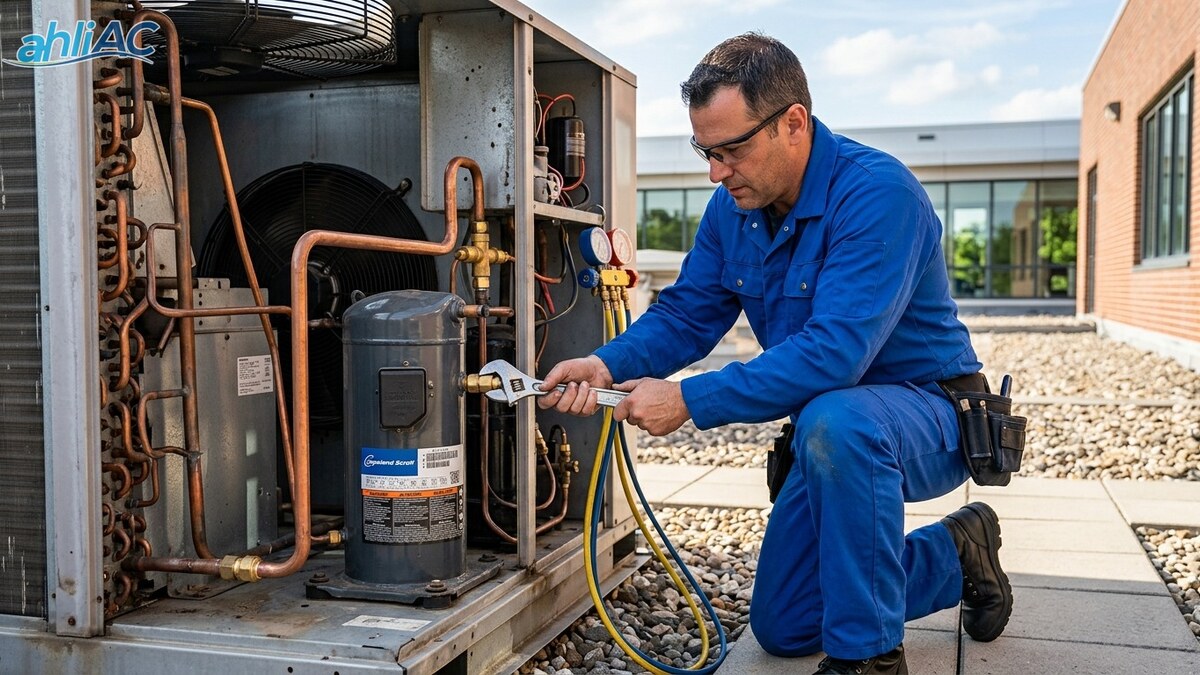
In this competitive landscape, Copeland Scroll compressors have long served as the industry benchmark, engineered specifically to meet and exceed rigorous Copeland Scroll Commercial Efficiency Standards. For HVAC professionals, consulting engineers, and facility managers, mastering the mechanics of compressor efficiency is critical. Every procurement decision—from component selection to overarching system architecture—exerts a profound, long-term impact on Total Cost of Ownership (TCO), corporate carbon footprints, and occupant productivity. Efficiency represents a strategic investment in intelligent operations, lower lifecycle expenses, and environmental stewardship.
The Efficiency Revolution: Why Copeland Scroll is the Pillar of Commercial HVAC
The compressor serves as the thermodynamic heart of any refrigeration or heat pump cycle; its mechanical efficiency directly dictates total system power consumption and reliability. Copeland scroll compressors have revolutionized commercial HVAC applications by maintaining exceptional volumetric efficiency across their entire operational lifecycle. Their innovative architecture provides distinct mechanical advantages over traditional reciprocating and rotary compression technologies.
A Brief History and Operating Principles of Scroll Compression
The concept of the scroll compressor was first patented in 1905 by French engineer Léon Creux. However, the extreme manufacturing tolerances required to seal the interleaving scrolls delayed its commercialization for decades. In the late 1970s, Copeland pioneered precision manufacturing techniques that enabled the mass production of scroll compressors for HVAC applications, fundamentally transforming the industry.
Unlike reciprocating compressors that rely on pistons and mechanical valves, or rotary compressors that utilize spinning vanes, a scroll compressor operates using two interleaving, Archimedean spiral scrolls. One scroll remains stationary, while the second orbiting scroll traces a circular path around the center of the fixed scroll without rotating on its own axis. This orbital motion creates a series of gas pockets that progressively decrease in volume as they move toward the center of the scroll assembly.
The Scroll Compression Cycle:
-
Suction: Low-pressure refrigerant vapor enters the outer boundary of the scroll assembly through the suction intake port.
-
Compression: As the orbiting scroll moves, it seals the refrigerant into discrete pockets between the scroll flanks. As orbital motion continues, these gas pockets are forced toward the center of the scroll, progressively decreasing in volume. This continuous reduction in volume steadily increases the refrigerant’s pressure and temperature.
-
Discharge: When the compressed gas reaches the center of the scroll assembly, it exits through a dedicated discharge port located in the center of the stationary scroll.
-
Continuous Cycle: Because compression occurs simultaneously across multiple gas pockets at various stages of compression, the process delivers a continuous, smooth, and pulse-free flow of high-pressure refrigerant vapor.
The primary thermodynamic advantage of scroll design is the virtual elimination of clearance volume—the dead space at the top of a reciprocating cylinder where compressed gas remains trapped after the discharge stroke. In reciprocating units, this residual high-pressure gas must re-expand before new suction gas can enter, severely degrading volumetric efficiency. Furthermore, the absence of suction and discharge valves eliminates mechanical valve losses, removes a major source of acoustic noise, and dramatically enhances mechanical reliability by reducing the number of moving parts subject to fatigue and wear.
Commercial Advantages of Scroll Architecture
The mechanical simplicity and continuous compression of scroll compressors translate into critical operational benefits for commercial HVAC plants, directly supporting adherence to Copeland Scroll Commercial Efficiency Standards:
-
High Volumetric Efficiency: The elimination of clearance volume and continuous orbital compression allow scroll compressors to displace a higher volume of refrigerant vapor per electrical Watt consumed, maximizing cooling and heating capacity.
-
Superior Acoustic and Vibration Profiles: Smooth orbital motion eliminates the intense mechanical vibrations and gas pulsations inherent to reciprocating strokes. This acoustic performance is critical for noise-sensitive commercial environments such as executive offices, hospitals, and luxury hotels.
-
Exceptional Mechanical Reliability: With approximately 70% fewer moving parts than traditional reciprocating compressors and minimal physical contact between scroll flanks (particularly in compliant scroll architectures), mechanical wear is drastically reduced. This extends equipment lifespan and minimizes disruptive system downtime.
-
Compact Footprint and Low Weight: Scroll compressors pack high capacity into a compact, lightweight shell. This simplifies mechanical room layout, reduces structural rooftop loads, and facilitates easier rigging during system retrofits.
-
Liquid Slugging Tolerance: A critical engineering advantage of Copeland’s radial and axial compliant scroll design is its ability to withstand incidental liquid refrigerant carryover (liquid slugging). The orbiting scroll can separate slightly from the stationary scroll to pass liquid droplets or solid debris without causing catastrophic valve or scroll flank damage.
-
Part-Load Modulation Capabilities: Advanced scroll architectures—such as variable-speed (inverter) and Digital Scroll models—enable precise capacity modulation. Because commercial buildings operate at part-load conditions over 90% of the time, matching compressor output to real-time thermal demand yields substantial electrical savings.
Understanding Commercial Energy Efficiency Standards: Critical Metrics for Procurement
Making informed B2B procurement decisions in commercial HVAC requires an exhaustive understanding of industry efficiency metrics. These standards quantify how effectively a system converts electrical power into thermal capacity. Adhering to Copeland Scroll Commercial Efficiency Standards requires evaluating how compressors perform across both full-load and part-load operational profiles.
SEER, EER, and COP: Foundational Efficiency Metrics
Three core metrics govern standard equipment ratings:
-
SEER (Seasonal Energy Efficiency Ratio): Primarily utilized for residential and light commercial equipment in North America, SEER measures total cooling output (in BTUs) divided by total electrical energy input (in Watt-hours) over a simulated cooling season. SEER accounts for varying ambient outdoor temperatures and cycling losses, providing a seasonal baseline.
-
EER (Energy Efficiency Ratio): Measures instantaneous cooling efficiency at a standardized peak full-load condition (typically $95^\circ\text{F}/35^\circ\text{C}$ outdoor ambient and $80^\circ\text{F}/27^\circ\text{C}$ indoor return air at 50% relative humidity). EER is vital for evaluating commercial plants operating in continuously hot climates or high-internal-load facilities where peak electrical demand charges are severe.
-
COP (Coefficient of Performance): A dimensionless, universal metric used globally for both cooling and heating modes. COP represents the ratio of useful thermal energy transferred to electrical energy input ($\text{COP} = \frac{\text{Thermal Output (Watts)}}{\text{Electrical Input (Watts)}}$). In heat pump applications, COP is the primary metric for evaluating winter heating efficiency.
While full-load metrics like EER and peak COP provide benchmark comparisons, they do not reflect actual commercial operating conditions. Field studies confirm that commercial HVAC plants operate at full design capacity less than 5% to 10% of the year. For over 90% of their operational lifespan, systems run at part-load conditions driven by fluctuating weather, variable occupancy, and solar shifting.
IPLV and NPLV: Real-World Part-Load Indicators
To capture real-world part-load efficiency, the Air-Conditioning, Heating, and Refrigeration Institute (AHRI) established Integrated Part Load Value (IPLV) and Non-standard Part Load Value (NPLV) under AHRI Standard 550/590.
-
IPLV (Integrated Part Load Value): A weighted average efficiency metric that evaluates chiller and compressor performance across four specific load points: 100%, 75%, 50%, and 25% capacity. The weighting reflects the actual percentage of operating hours a typical commercial plant spends at each load point during a standard year.
-
NPLV (Non-standard Part Load Value): Applies the exact same weighted methodology as IPLV but utilizes local, site-specific entering condenser water temperatures or ambient air profiles rather than standard AHRI laboratory conditions. NPLV is essential for custom commercial installations in unique climate zones.
IPLV Calculation Methodology
The IPLV formula is mathematically weighted to reflect real-world commercial building operations:
$$\text{IPLV} = (0.01 \times A) + (0.42 \times B) + (0.45 \times C) + (0.12 \times D)$$
Where:
-
$A = \text{EER or COP at } 100\% \text{ capacity (1\% of operating hours)}$
-
$B = \text{EER or COP at } 75\% \text{ capacity (42\% of operating hours)}$
-
$C = \text{EER or COP at } 50\% \text{ capacity (45\% of operating hours)}$
-
$D = \text{EER or COP at } 25\% \text{ capacity (12\% of operating hours)}$
This formula highlights that a system spends 87% of its operating hours at 50% and 75% capacity. Consequently, a compressor with a moderate full-load EER but an exceptionally high part-load EER at the 50% and 75% test points will deliver significantly lower annual energy costs. Copeland Scroll compressors—particularly multi-stage, inverter-driven, and Digital Scroll configurations—are engineered specifically to maximize IPLV, driving down annual operational expenditure (OPEX).
Regulatory Compliance: SNI, ASHRAE, and Green Building Frameworks
Adhering to efficiency standards is both a legal requirement and a commercial differentiator:
-
Indonesian National Standards (SNI): In Indonesia, commercial HVAC equipment must comply with mandatory energy performance standards such as SNI 7069.2:2018. Compliance ensures equipment meets minimum Energy Efficiency Ratio (EER) thresholds, protecting building owners from inefficient utility drains.
-
ASHRAE Standards: Internationally, the American Society of Heating, Refrigerating and Air-Conditioning Engineers sets the technical baseline for sustainable building engineering. ASHRAE Standard 90.1 establishes mandatory minimum energy efficiency requirements for commercial HVAC equipment, chillers, and rooftop units. Copeland designs its commercial scroll portfolio to exceed ASHRAE 90.1 baselines.
-
Green Building Certifications: High IPLV and EER ratings achieved through Copeland Scroll technology directly contribute to earning energy efficiency credits in green building rating systems, including LEED (Leadership in Energy and Environmental Design), BREEAM, Singapore’s Green Mark, and Indonesia’s GREENSHIP framework. Buildings achieving these certifications command higher rental rates, benefit from tax incentives, and attract ESG-conscious corporate tenants.
Copeland Scroll Technology in Achieving Peak Efficiency
Copeland’s attainment of superior efficiency ratings is driven by continuous mechanical and electronic innovation. The engineering architectures embedded within modern Copeland commercial compressors address specific thermodynamic losses to maximize performance.
Copeland ZR Series: Mechanical Engineering Evaluation
The Copeland ZR Series represents a workhorse within commercial air conditioning and chiller markets. A technical evaluation of the ZR series reveals several proprietary engineering enhancements:
-
Axial and Radial Compliant Scroll Design: Copeland’s compliant architecture allows the orbiting scroll to separate slightly in both axial and radial directions under abnormal pressure spikes. If liquid refrigerant or particulate debris enters the compression chamber, the scrolls separate to pass the slug without inducing mechanical stress or bearing seizure. This compliance also allows the scrolls to “wear in” rather than “wear out,” maintaining tight seals and high volumetric efficiency over years of continuous operation.
-
Optimized Internal Flow Pathing: Suction and discharge gas internal porting is aerodynamically shaped to minimize pressure drop and internal gas turbulence. By reducing internal flow resistance, more electrical energy is converted directly into useful compression work.
-
High-Efficiency Motor Stators: ZR Series compressors integrate precision-wound, high-efficiency electrical induction motors. Utilizing high-grade silicon steel laminations and optimized slot fill geometry, these motors minimize $I^2R$ electrical resistance losses and thermal dissipation, maintaining high motor efficiency across diverse load profiles.
-
Enhanced Vapor Injection (EVI): Selected commercial scroll models feature EVI technology. EVI injects mid-pressure saturated refrigerant vapor from an external economizer plate heat exchanger directly into an intermediate compression pocket within the scroll set. This subcools the main liquid refrigerant line—increasing evaporator cooling enthalpy—while cooling the compressor discharge gas. EVI significantly boosts cooling capacity and EER, particularly under high-ambient condensing conditions.
-
Advanced PTFE Bearing Systems: High-load drive bearings utilize Polytetrafluoroethylene (PTFE) and porous bronze composite coatings. These advanced bearing materials reduce mechanical friction, operate reliably under marginal lubrication conditions, and extend operational lifespans.
Variable Speed (Inverter) Scroll Technology
Integrating Variable Frequency Drives (VFDs) with Copeland Scroll compressors represents a transformational leap in commercial HVAC efficiency. Fixed-speed compressors operate on a rigid ON/OFF cycle; when thermal demand drops, the compressor cycles off, incurring thermal cycling losses and electrical start-up spikes. Inverter-driven scroll compressors modulate their rotational speed—typically from 15 Hz up to 120 Hz—matching refrigerant mass flow exactly to the real-time thermal load of the building.
Strategic Advantages of Inverter Scroll Compression:
-
Proportionate Energy Reduction: The affinity laws of fluid dynamics dictate that mechanical power consumption drops cubicly or quadratically with rotational speed. When an inverter scroll slows down to meet a 50% part-load condition, power consumption drops dramatically, yielding energy savings of 30% to 50% compared to fixed-speed staged systems.
-
Elimination of Inrush Current: Inverter drives initiate compressor rotation through a controlled “soft start,” gradually ramping up frequency and voltage. This eliminates the massive starting current surges (Locked Rotor Amps) associated with direct-on-line (DOL) fixed-speed compressors, preventing grid voltage sags and reducing utility peak demand charges.
-
Precise Temperature and Humidity Control: Continuous capacity modulation allows systems to maintain space temperatures within a strict $\pm0.5^\circ\text{C}$ deadband. Furthermore, running continuously at reduced speeds lowers evaporator coil surface temperatures, providing superior latent heat removal (dehumidification) without over-cooling the sensible space temperature.
Next-Generation Low-GWP Refrigerant Optimization
As global environmental treaties like the Kigali Amendment phase down high-Global Warming Potential (GWP) hydrofluorocarbons (HFCs), Copeland has proactively re-engineered its scroll portfolio to operate efficiently with low-GWP and natural refrigerants:
-
R410A vs. R32 Transition: While R410A ($\text{GWP} = 2088$) remains widespread, the commercial industry is rapidly shifting toward R32 ($\text{GWP} = 675$). R32 offers approximately 10% higher volumetric cooling capacity and superior thermal conductivity compared to R410A. Copeland has optimized its scroll internal discharge port geometry and synthetic Polyolester (POE) oil formulations specifically to handle R32’s higher discharge temperatures and A2L (mildly flammable) operating characteristics.
-
Ultra-Low GWP and Natural Refrigerants: For long-term sustainability, Copeland has developed scroll compressors certified for ultra-low GWP hydrofluoroolefins (HFOs) and blends such as R454B ($\text{GWP} = 466$), as well as natural refrigerants including Propane (R290, $\text{GWP} = 3$) and Carbon Dioxide (R744 / $\text{CO}_2$, $\text{GWP} = 1$). Operating with $\text{CO}_2$ requires transcritical compression at extreme operating pressures (exceeding 100 bar); Copeland’s specialized structural shell designs and high-pressure scroll profiles ensure safe, high-efficiency operation under these demanding thermodynamic regimes.
Digital Scroll Technology: Mechanical Capacity Modulation
For commercial applications where the electronic complexity or capital cost of a Variable Frequency Drive is not desired, Copeland’s proprietary Digital Scroll technology provides infinitely variable capacity modulation between 10% and 100% at a fixed motor speed.
Operating Principles:
Digital Scroll modulation relies on an axial compliance mechanism controlled by an external solenoid valve. When the solenoid valve is de-energized, the compression chamber functions normally (Loaded State). When the system controller energizes the solenoid valve, a small volume of high-pressure discharge gas is vented to the suction side, allowing the top stationary scroll to move upward by approximately 1 millimeter. This tiny separation breaks the seal between the interleaving scroll flanks (Unloaded State).
In the unloaded state, the compressor motor continues to rotate at constant speed, but no refrigerant compression occurs, reducing compressor power consumption to approximately 10% of full load (overcoming only mechanical friction and motor losses). By modulating the time-averaged ratio of loaded versus unloaded states within a fixed window (e.g., a 20-second cycle), the compressor delivers precise capacity control. For example, operating loaded for 10 seconds and unloaded for 10 seconds yields an exact 50% capacity output.
Tangible Business Impact of Copeland Scroll Efficiency
Investing in commercial HVAC equipment engineered to Copeland Scroll Commercial Efficiency Standards generates measurable financial, environmental, and operational returns that extend far beyond simple utility bill reductions.
Minimizing Total Cost of Ownership (TCO)
In B2B capital equipment procurement, evaluating systems strictly by initial capital expenditure (CAPEX) is a flawed methodology. Over a typical 15- to 20-year commercial HVAC lifecycle, initial CAPEX accounts for less than 15% of the total financial outlay; electrical OPEX and maintenance account for over 85%.
-
Dramatic Electrical OPEX Reductions: Specifying high-IPLV Copeland Scroll chillers or VRF systems reduces annual electrical consumption by 25% to 40% compared to baseline commercial equipment. In large commercial facilities, this translates to tens of thousands of dollars in annual savings, generating a rapid Return on Investment (ROI)—often within 2 to 4 years.
-
Reduced Maintenance Expenditures: The compliant scroll architecture eliminates valves, connecting rods, and wrist pins. Fewer mechanical parts equate to lower mechanical vibration, reduced bearing stress, and minimal wear. This drastically lowers routine maintenance costs, reduces the frequency of component overhauls, and extends total equipment lifespan.
-
Mitigation of Unplanned Downtime: In commercial enterprises, HVAC failure disrupts operations, halting retail trade, damaging data center infrastructure, or forcing office closures. The exceptional reliability of Copeland Scroll compressors guarantees business continuity and protects revenue streams.
Carbon Footprint Reduction and ESG Compliance
Environmental, Social, and Governance (ESG) mandates now heavily influence corporate real estate valuations and institutional investment criteria.
-
Scope 2 Emission Reductions: By slashing electrical consumption, high-efficiency scroll compressors directly reduce facility Scope 2 greenhouse gas emissions (emissions associated with purchased electricity).
-
Scope 1 Emission Reductions: Transitioning to Copeland scroll compressors optimized for low-GWP refrigerants (R32, R454B, R290) mitigates Scope 1 direct emissions resulting from incidental refrigerant leaks over the equipment lifecycle.
-
Corporate Reputation and Asset Valuation: Sustainable buildings command higher occupancy rates and premium lease rates. Complying with international efficiency standards positions corporations as responsible environmental stewards, enhancing brand equity among consumers and stakeholders.
Enhancing Indoor Environmental Quality (IEQ) and Productivity
The performance of an HVAC system directly impacts human health, cognitive function, and workplace productivity.
-
Precision Thermal Comfort: Inverter and Digital Scroll systems eliminate the wide temperature swings associated with conventional ON/OFF thermostats. Maintaining a precise, stable thermal environment ($\pm0.5^\circ\text{C}$) prevents occupant discomfort and reduces facility management complaints.
-
Superior Dehumidification: In humid tropical climates like Indonesia, high relative humidity breeds mold, mildew, and airborne bacteria while degrading thermal comfort. Inverter scroll systems running at extended part-load speeds maintain cold evaporator coils, efficiently extracting latent moisture from the air stream without over-cooling the space.
-
Acoustic Quietness: Low operational noise and vibration levels create productive, distraction-free work environments in offices and serene atmospheres in healthcare and hospitality settings.
Critical Commercial Applications Relying on Copeland Scroll
The engineering versatility, reliability, and part-load efficiency of Copeland Scroll compressors make them the preferred choice across diverse commercial sectors with mission-critical climate control requirements.
Data Centers and Server Rooms
Data centers represent high-density sensible heat environments requiring 24/7/365 uninterrupted cooling. A mechanical cooling failure can cause thermal runaway within minutes, destroying critical servers and causing catastrophic data loss.
-
Why Copeland Scroll Excel: Precision inverter scroll compressors respond instantly to dynamic server computational loads, preventing temperature spikes. Their exceptional mechanical reliability guarantees continuous operation, while high part-load EER ratings curb the massive electrical loads associated with data center cooling infrastructure.
Commercial Office Buildings and Retail Centers
Commercial real estate exhibits highly variable thermal loads driven by diurnal weather shifts, shifting solar angles, and fluctuating occupant density.
-
Why Copeland Scroll Excel: High IPLV ratings achieved through multi-staged scroll arrays or Variable Speed Drives ensure that air handling units and rooftop packages operate at peak electrical efficiency during morning start-ups, mid-day solar peaks, and evening pull-downs. Quiet operation prevents acoustic interference in open-plan office environments.
Hospitals and Healthcare Facilities
Healthcare facilities require stringent environmental control to prevent hospital-acquired infections (HAIs), preserve pharmaceutical integrity, and maintain sterile operating theaters.
-
Why Copeland Scroll Excel: Compliant scroll reliability prevents catastrophic mechanical failures in life-critical clinical environments. Precision capacity modulation maintains exact temperature and humidity thresholds in surgical suites and intensive care units, while low vibration prevents interference with sensitive medical imaging equipment (e.g., MRI and CT scanners).
Hospitality and Hotel Complexes
The hospitality industry relies on providing guests with silent, comfortable, and uninterrupted environmental control.
-
Why Copeland Scroll Excel: In guest rooms and public lobbies, scroll compressors operating within chillers or VRF outdoor units deliver whisper-quiet cooling. Modulating capacity allows hotels to scale cooling energy down automatically during low-occupancy off-peak seasons, preserving operating margins.
Supermarkets and Commercial Refrigeration
In commercial retail food stores, refrigeration systems represent up to 50% of total facility energy consumption. Protecting perishable inventory from spoilage requires absolute temperature stability across medium- and low-temperature display cases.
-
Why Copeland Scroll Excel: Copeland refrigeration scrolls engineered for continuous low-temperature operation maintain strict temperature uniformity. Their compatibility with natural refrigerants ($\text{CO}_2$ and Propane) allows supermarket chains to meet aggressive decarbonization targets while lowering energy OPEX.
The Future of Commercial HVAC Efficiency
As global decarbonization accelerates, Copeland continues to advance scroll compression technology, integrating digital intelligence and advanced materials to meet future commercial demands.
Smart Building Integration and IIoT Telemetry
The integration of the Industrial Internet of Things (IIoT) transforms commercial compressors from passive mechanical devices into intelligent edge computing sensors. Modern Copeland Scroll compressors integrate advanced electronic control modules that stream real-time telemetry—including discharge temperatures, current draw, phase symmetry, oil pressure, and vibration harmonics—directly to cloud-based Building Management Systems (BMS).
-
Predictive Maintenance: Machine learning algorithms analyze historical telemetry to detect micro-anomalies (e.g., a fractional increase in motor current or discharge temperature drift) weeks before physical component failure occurs. Facility managers can schedule proactive maintenance during planned shutdown windows, eliminating catastrophic failures.
-
Algorithmic Grid Integration: Smart scroll plants communicate with municipal smart grids. During peak electrical grid demand events, automated demand-response algorithms modulate inverter scroll speeds downward slightly, shedding facility electrical load in exchange for utility billing credits without compromising occupant comfort.
Evolving Global Efficiency Mandates
Regulatory bodies worldwide are systematically tightening Minimum Energy Performance Standards (MEPS). In Europe, the F-Gas Regulation is aggressively phasing out HFCs, while the US EPA’s AIM Act enforces similar phasedowns. Future HVAC standards will increasingly penalize equipment with high lifecycle carbon emissions. Copeland is already deploying next-generation scroll architectures engineered to achieve net-zero operational carbon when paired with renewable energy grids.
Selecting the Right Copeland Scroll for Your Application
To maximize capital investment and ensure compliance with Copeland Scroll Commercial Efficiency Standards, B2B decision-makers and mechanical engineers must execute a rigorous selection protocol:
-
Conduct Precision Load Calculations: Utilize certified HVAC modeling software to calculate exact sensible and latent heat gains. Avoid sizing by “rules of thumb”; oversizing equipment degrades part-load efficiency and impairs dehumidification performance.
-
Evaluate Part-Load Requirements (IPLV over EER): If the commercial facility operates under variable loads (e.g., office buildings, shopping malls), prioritize equipment with superior IPLV/NPLV ratings over peak full-load EER. Specify Variable Speed (Inverter) or Digital Scroll compressors to capture part-load electrical savings.
-
Align with Environmental Mandates: Specify compressors certified for low-GWP refrigerants (R32, R454B) or natural refrigerants ($\text{CO}_2$, R290) to future-proof the installation against evolving environmental regulations and chemical phase-downs.
-
Demand IIoT Compatibility: Ensure specified compressor equipment includes factory-integrated electronic control modules capable of communicating via standard building protocols (Modbus RTU, BACnet IP/MSTP) to enable predictive analytics and remote monitoring.
-
Perform Lifecycle TCO Analysis: Request comprehensive Total Cost of Ownership evaluations from equipment suppliers, factoring in 15-year energy projections, routine maintenance scheduling, and local utility rebate programs for high-efficiency equipment.
Conclusion: A Strategic Investment in Performance and Sustainability
In the modern B2B commercial landscape, energy efficiency is no longer an optional engineering upgrade; it is the cornerstone of operational profitability, asset valuation, and corporate sustainability. Copeland Scroll compressors have proven themselves as the undisputed mechanical foundation of high-performance commercial HVAC systems, consistently exceeding rigorous Copeland Scroll Commercial Efficiency Standards.
From proprietary compliant scroll engineering that survives extreme mechanical stress, to Variable Speed and Digital Scroll architectures that master part-load efficiency, every dimension of Copeland technology is optimized for superior performance. The operational returns are definitive: substantial reductions in Total Cost of Ownership (TCO) through slashed electrical OPEX, aggressive mitigation of corporate Scope 1 and Scope 2 carbon emissions, and the delivery of precision indoor environmental quality that enhances human productivity.
For mechanical engineers, facility managers, and corporate procurement officers, specifying Copeland Scroll technology represents a secure, forward-looking strategic investment. It guarantees adherence to evolving international energy standards, ensures mission-critical mechanical reliability, and positions commercial facilities at the forefront of the global transition toward sustainable, high-performance building engineering.