Deep Dive: Air Handling Unit (AHU) vs. Fan Coil Unit (FCU) for Beginners
In the world of HVAC (Heating, Ventilation, and Air Conditioning), we often hear technical acronyms that sound similar but serve vastly different purposes. Two of the “main characters” that often confuse building owners or junior technicians are the Air Handling Unit (AHU) and the Fan Coil Unit (FCU).
If you’ve ever walked into a hotel lobby and felt a massive, refreshing breeze, then stepped into your room where you could adjust the temperature with a remote, you’ve experienced both systems at work.
At ahliAC, we frequently encounter questions like: “Which one should my building use?” or “Why is the maintenance contract for the AHU so much more expensive than the FCU?”
Let’s break down the differences not with stiff textbook definitions, but by looking at how these two units actually “breathe life” into your building’s circulation.
The Core Concept: The Massive AHU vs. The Agile FCU

Think of your building’s HVAC system as a human body.
The Air Handling Unit (AHU) is the lungs. It’s huge often the size of a shipping container or a giant wardrobe and is usually hidden away in a dedicated mechanical room, the basement, or on the rooftop. Its main job isn’t just to cool the air; its job is to treat the air.
The AHU pulls in fresh air from outside (fresh air intake), filters it through multiple stages, cools it via giant coils, regulates humidity, and then pushes it back out to the entire building through a complex network of ducting.
On the other hand, the Fan Coil Unit (FCU) is the local worker. As the name suggests, it’s practically just a fan and a coil. The FCU doesn’t usually pull air from outside. Instead, it takes the air already inside the room, cools it down, and spins it back out (recirculation).
The FCU is the unit tucked inside the ceiling of your meeting room or hidden behind the wall in a hotel guest room.
The Technical Differences That Matter in the Field
Physically, the size difference is obvious. But for those managing building operations, the critical differences lie in these three aspects:
1. Location and Installation Complexity

Installing an AHU is a major construction project. Because it requires a dedicated mechanical room, the AHU is typically connected to a central Chiller system. The chilled water pipes entering an AHU are large and require thick insulation to prevent condensation (sweating) in the machine room.
The FCU is much more flexible. It can be installed above the ceiling (ceiling concealed), mounted on the wall, or as a cassette model. The FCU doesn’t need a machine room. Give it a chilled water pipe connection (for hydronic systems) or copper refrigerant pipes (for DX/VRF systems), a drainage line, and power, and it’s good to go.
2. Air Distribution System (Ducting vs. Direct)
This is the easiest way to tell them apart:
- AHU almost exclusively uses ducting. Cold air is pushed with high static pressure so it can reach distant areas. Because it uses ducting, a single AHU can serve a massive area (like a mall atrium, ballroom, or factory floor).
- FCU is typically direct blow or uses very short ducting. Its reach is limited, designed to serve a single room or a small zone.
3. Indoor Air Quality (IAQ) Control
This is where the AHU wins hands down. Because the AHU has plenty of space, we can install various add-on modules. Need a HEPA filter for a hospital? Doable. Need a humidifier to protect a server room? Easy. Want to precisely control how much fresh air enters (mixing box)? Absolutely.
FCUs generally only have a simple dust filter (often just a thin nylon mesh). So, while the FCU is great at cooling, it isn’t as capable as the AHU when it comes to deep cleaning the air.
When Should You Use an AHU, and When is an FCU Enough?
It’s rarely a choice of one or the other because, in large buildings (like 5-star hotels or hospitals), they are often used together.
Use an AHU if:
- You need to cool a large, open area without partitions (Mall lobbies, auditoriums, factories).
- Indoor Air Quality (IAQ) is a top priority (Operating theaters, Clean rooms).
- You need precise humidity control.
- Machine noise must be completely inaudible in the cooled area (The AHU creates noise, but it’s isolated in a room far away).
Use an FCU if:
- You need individual temperature control for different rooms (Hotel rooms, leased office spaces).
- Installation space is tight (no room for large ducting).
- You want energy efficiency per zone (If Meeting Room A is empty, you can turn off its FCU without affecting the room next door).
Maintenance Challenges: The ahliAC Technician’s Perspective

Based on our field experience, issues with these units have distinct characters.
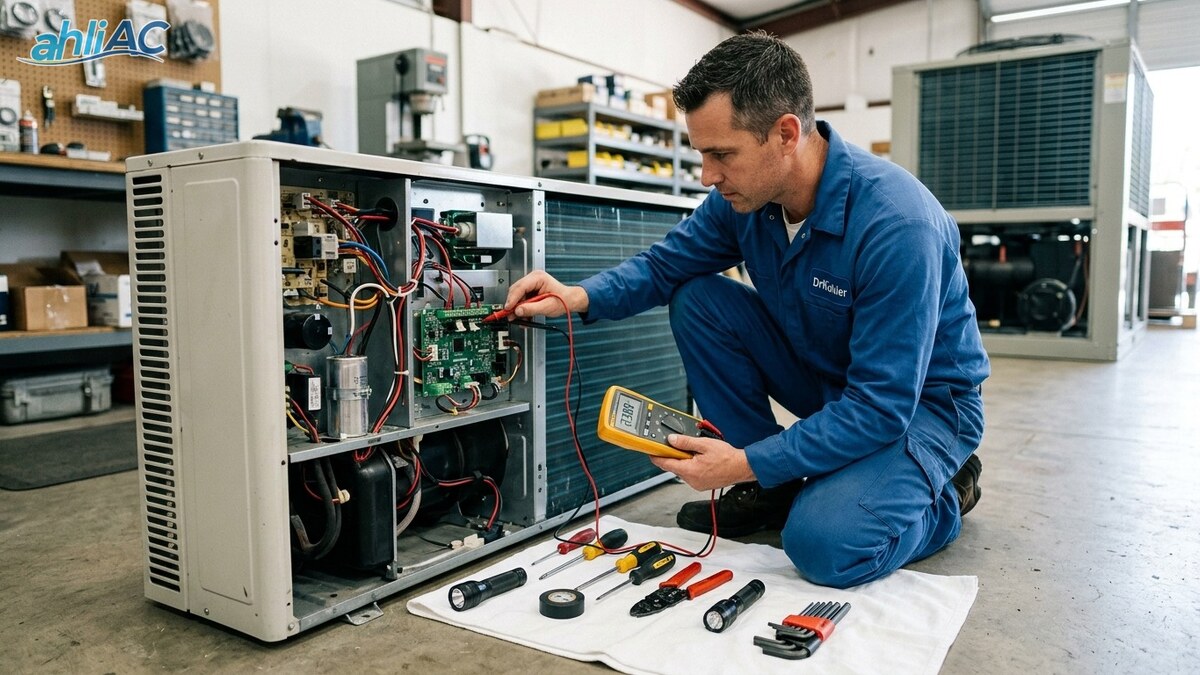
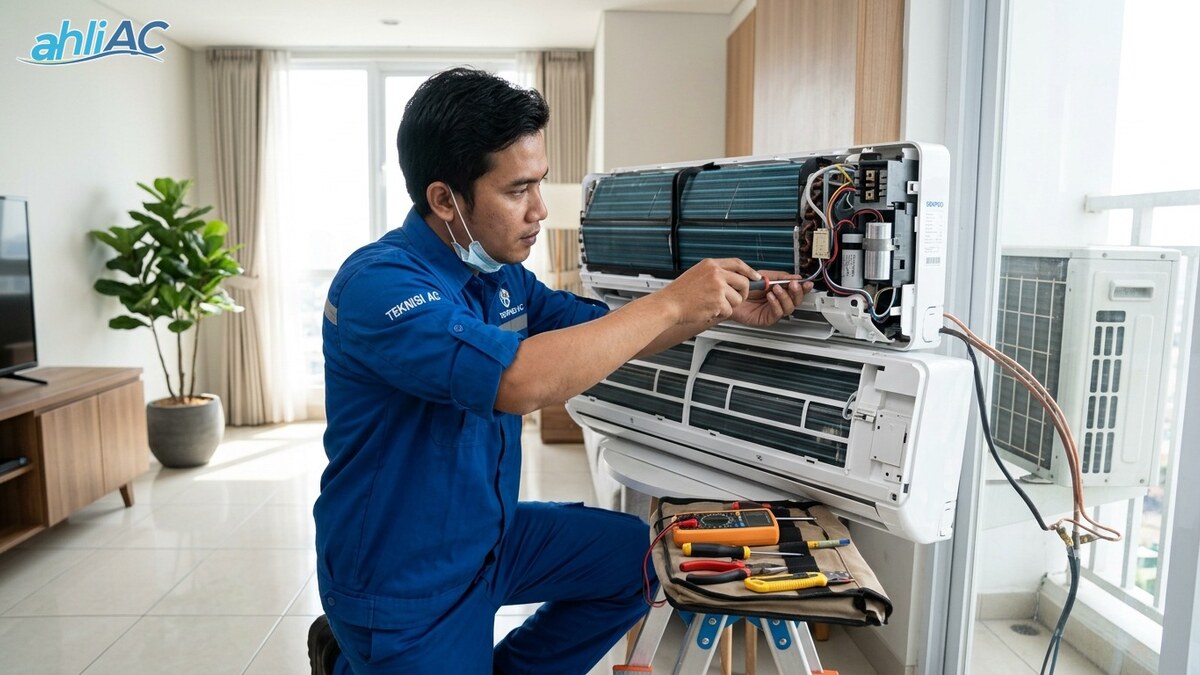
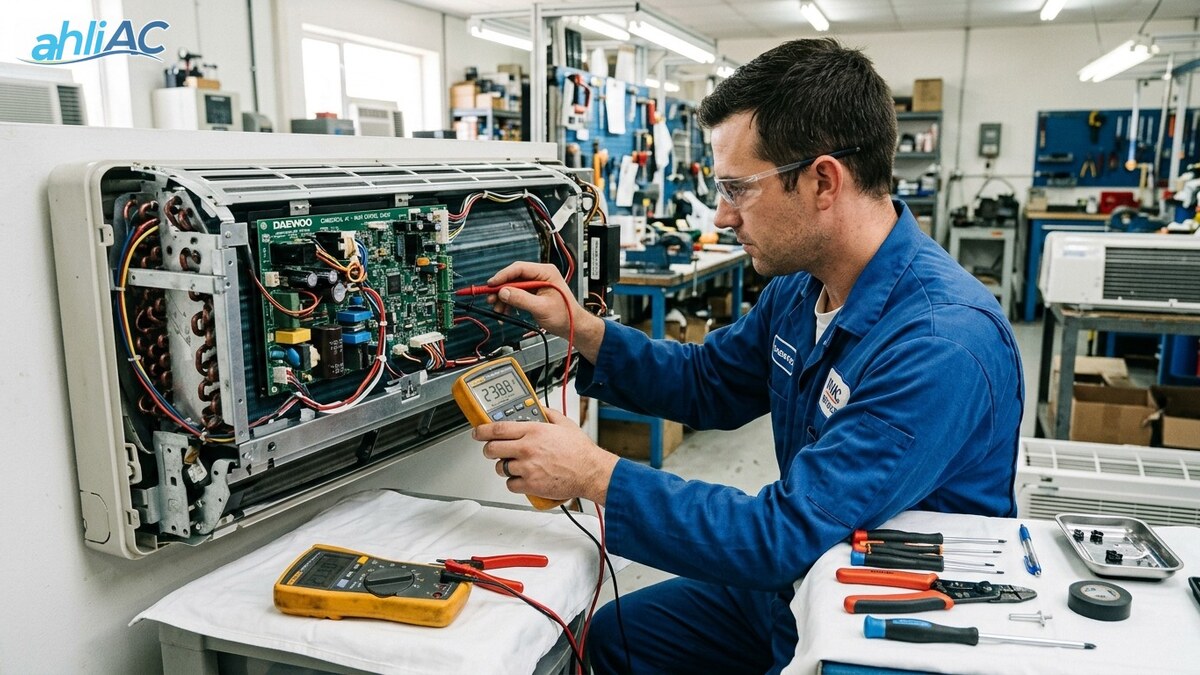
With the FCU, the classic problem is “water leaking” or condensate dripping. This frequently happens because the drain pan gets clogged with slime, algae, or jelly like buildup. Since FCUs are often positioned above a fixed gypsum ceiling, maintenance is a headache. Technicians often have to cut a manhole just to access the unit for service. Additionally, the motor fan bearings can wear out over time, causing a noisy rattling sound right above your head.
With the AHU, the challenges are on a macro scale:
- Loose or Broken V-Belts: This causes the fan to spin, but the airflow drops drastically or stops entirely.
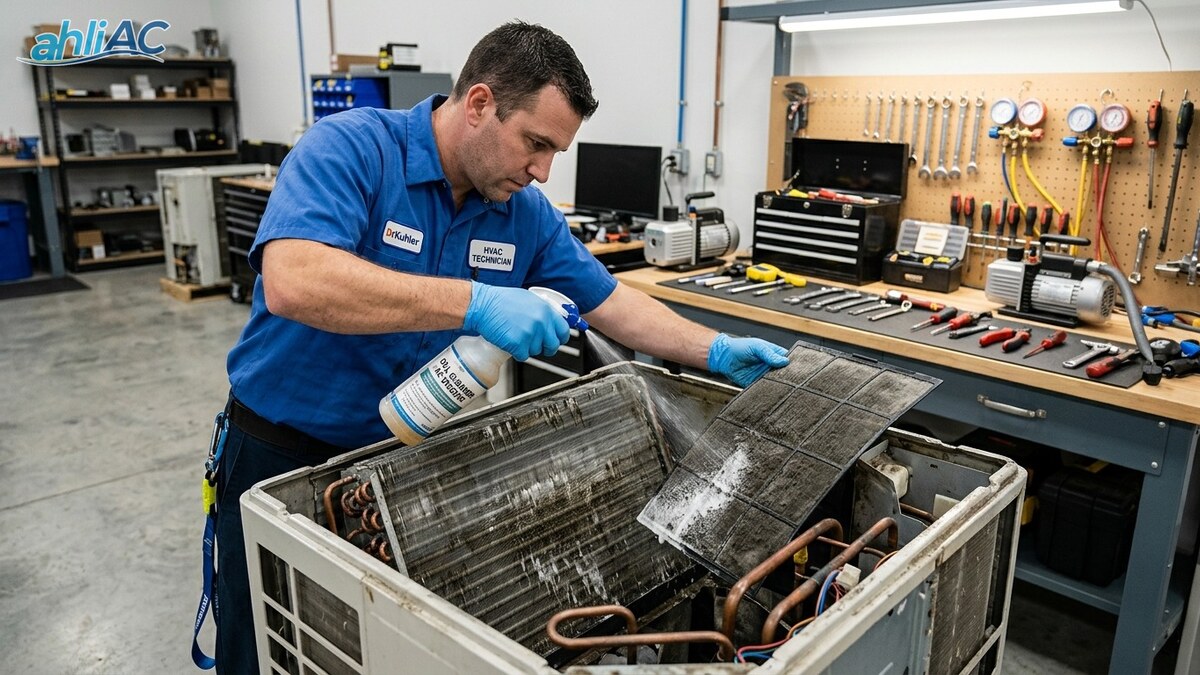
- Blocked Filters: Because the AHU filters dirty outside air, the filters turn black very quickly. If you delay cleaning, the static pressure spikes, which can cause the coil to freeze up (frosting) or even make the ducting vibrate violently.
- Stuck Dampers: Sometimes the mechanism that regulates fresh air gets stuck, causing the cooling load to skyrocket because too much hot outside air is being let in.
The ahliAC team always advises: For FCUs, clean the filters routinely once a month. For AHUs, the checklist is longer ranging from checking pulley alignment and greasing bearings to performing chemical washes on the evaporator coils.
Quick Comparison: AHU vs. FCU
| Feature | Air Handling Unit (AHU) | Fan Coil Unit (FCU) |
| Capacity | Large (High CFM) | Small – Medium |
| Area Served | Large/Open Areas (Malls, Factories) | Single Room/Zone (Offices, Bedrooms) |
| Air Supply | Fresh Air Intake + Return Air | Recirculated Room Air |
| Complexity | High (Requires Ducting & Machine Room) | Low (Pipes & Cables only) |
| Maintenance | Centralized in one room | Scattered across many ceiling points |
Final Thoughts
Choosing between an AHU and an FCU, or combining them, is a long-term investment decision. The AHU provides superior air quality and centralized control, while the FCU offers flexibility and zonal efficiency.
Most importantly, no matter how sophisticated your AHU or FCU system is, performance will plummet without disciplined preventive maintenance. Don’t wait until the ceiling leaks or the compressor overheats to call for help.
If you are unsure about the condition of your building’s HVAC system, the ahliAC team is ready to assist with audits and precision maintenance.
Frequently Asked Questions
Q: Does an AHU consume a lot of electricity?
A: It depends on the design. While an AHU has a large motor that draws high power, its total efficiency (COP) is often better than installing hundreds of small split ACs to cool the same massive area.
Q: Can an FCU take in fresh air from outside?
A: Yes, but it’s limited. Usually, an FCU can be connected to a small duct for fresh air intake, but its capacity to treat and filter that air is nowhere near as comprehensive as an AHU.
Q: How often should AHU filters be changed?
A: Pre-filters (coarse filters) should be washed every month. Bag filters or fine filters typically need replacement every 3 to 6 months, depending on the air pollution levels around your building.